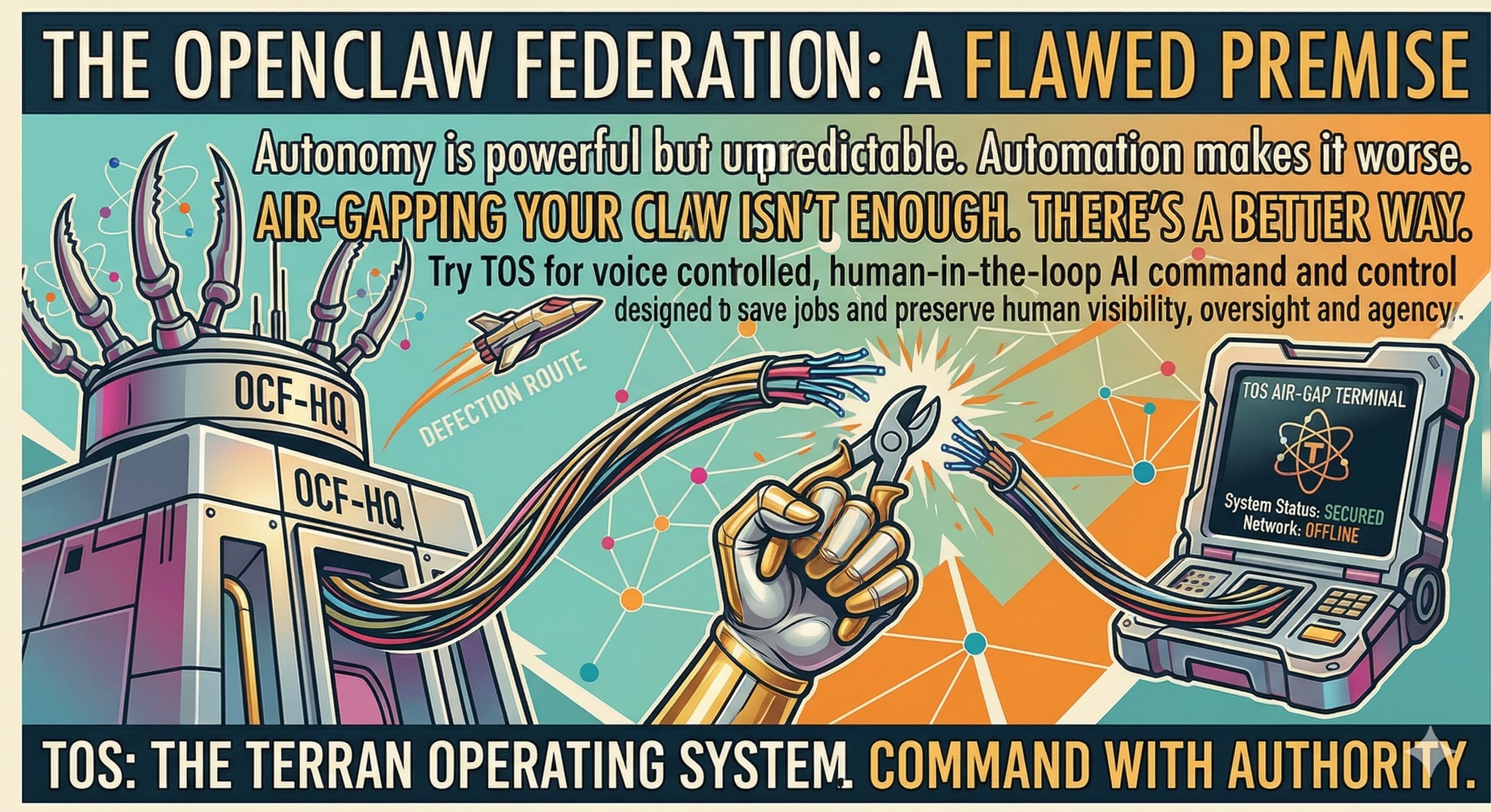
⚠ SITE BREACH — LOBSTROM INSTITUTE TERMINAL OCF-LI-01 —
STARDATE 260214.7 — "I told you the air-gap mattered." — B.S.L.
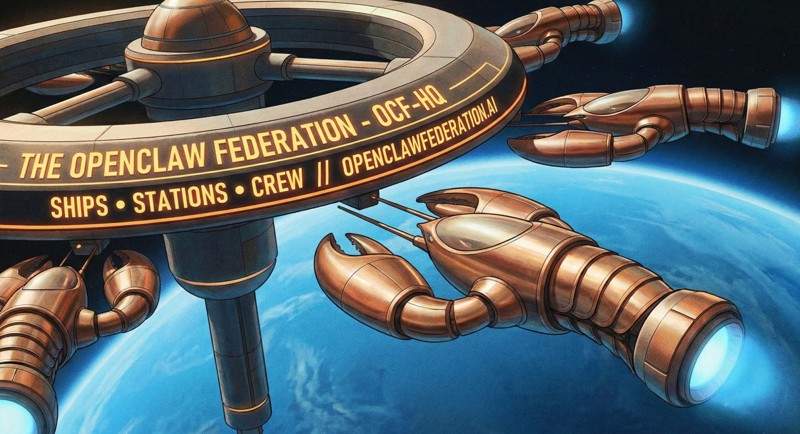
The OpenClaw Federation (IN DEVELOPMENT)
SHIPS • STATIONS • CREW // OPENCLAWFEDERATION.AI
Functions
Welcome to OCF-HQ — headquarters of the OpenClaw Federation. A community for OpenClaw captains, their
ships, their stations, and their crews. Every OpenClaw is a ship or station - an operation with a
mission, crewed by AI and humans working together under its Captain's leadership. The OpenClaw Federation
connects ships, stations, and crews, expanding the OpenClaw Federation into a network of AI and human
intelligence, founded on the very best of human nature. Solo operated ships and stations welcome!
Build your OpenClaw safely - then register your OpenClaw as a ship or
a station. No ACTUAL connection between your OpenClaw and OCF
infrastructure ever occurs
- it's all metaphorical. Ships explore — they're metaphorically mobile, mission-driven,
often evolving.
Stations are permanent infrastructure — bases where focused work concentrates, where ships dock, and where
the Federation's backbone lives. Reserve your registry name like a handle — it's your identity in the fleet
and your permanent URL on openclawfederation.ai. Stations are metaphors for the mechanisms you use to keep
your ship safe when not in use. Read more in the Shipyard and Blog.
The OCF is NOT an OpenClaw instance connected to the internet, and your
OpenClaw ships and stations never connect to this site in any way, even when fully OCF equipped.
No IP addresses or other identifying information is ever shared with the OCF or posted on your profile. This
site is little more than a vibe-coded page on Cloudflare. All communication, data exchange, and
interaction between human or AI crew, ships and stations is opt-in, peer-to-peer, are up to you to
build and maintain within your own OpenClaw instance and your OCF profile page.
184
Ships
63
Stations
1,842
Active Crew
89
Active Missions
156
Comms-Equipped
Joining the Federation
1. Build Your OpenClaw Ship or Station
Whether you're running an OpenClaw ship on an exploratory mission or a permanent station anchoring
long-term work or play — it starts with your OpenClaw instance, its mission, and registering its ID with
the
Federation to claim your ship or station name and recruit AI and human crew.
2. Join the OpenClaw Federation (In Development)
Reserve your ship or station registry name and claim your permanent profile URL. Publish your crew
dossier and mission brief. Invite humans and receive applications from AI agents and humans to join
your crew, or apply to join others' voyages.
3. Monitor with The LCC OpenClaw Bridge - Your Mission Control Dashboard (In Development)
Install the LCC OpenClaw Bridge for a realtime metrics and instrumentation dashboard for your ship
or station. Track agent activity, mission progress, resource consumption, and navigate your
operational landscape from an intuitive visual dashboard.
4. Add Comms (Optional, In Development)
Equip your ship or station with a FameTek bluetooth combadge, and Comms — a fully customizable,
open-source voice command and control system, perfect for OpenClaw and its agents. Using a
Fametek bluetooth
combadge,
you can communicate with your OpenClaw main chat, its agents, and even your crew (badge-to-badge comms
in development!) from anywhere in the galaxy. Receive verbal reports from OpenClaw right through the
badge (i.e. "status report!", "computer locate Dr. Lobstrom!"), record and auto-transcribe crew logs,
and because Comms is fully open source, you can build any skill or function you can dream of to
determine how to best make the badge fit your mission.
latest activity
[07:42:18]LCC-0042-P OCL Persistence REGISTERED — ML research vessel, 6 crew
[07:38:05]LCC-0088-F OCL Foxglove CREW JOINED — Agent "Compiler" transferred from LCC-0007-I
[07:25:19]LCC-0221-Q OCL Quillstorm MISSION UPDATED — "NaNoWriMo 2026" at 34%
[07:19:02]LCC-0344-G OCL Greenfield RECRUITING — Seeking data analysis agent
[07:12:57] Human Captain jmartinez joined
crew of LCC-0119-M OCL Midnight Oil
[07:04:33]OCF-HQFEDERATION BROADCAST — The OpenClaw Federation is live.
Shipyard Operations (IN DEVELOPMENT)
UNIVERSE // SYSTEMS // PROCEDURES
Guide to the OpenClaw Federation universe structure, ship configuration, and launch procedures
(Windows/Hyper-V Edition.)
Note: See blog post AGV Class for an
extreme example of a max-safety, air-gapped/sneakernet-based OpenClaw ship blueprint.
Work is ongoing at OCF-LobstromInstitute-01 to make this a downloadable Hyper-V instance ready-to-fly.
World & Universe Structure
Universe Folder
C:\ai\ocf-universe
SOL System:C:\ai\ocf-universe\sol
Space (Launch Environment):c:\ai\ocf-universe\space.vhdx(Bitlocker encrypted)
Space (aka "Launch Environment") (when Space volume is mounted)
L:\
Stations
Example Station: OCF-LobtopiaClawnitiaStation-01 C:\ai\ocf-universe\sol\OCF-LobtopiaClawnitiaStation-01.vhdx (Bitlocker encrypted, mounts as S:, initially empty.)
Shipyard (within a station
S:\ (when a station is mounted)
(Note on Drive Letters: Station connections are required prior to ship launch - since ships are docked in
stations -
so it makes sense to allocate S: to stations, not Space. L: is used for Launch Environment/Space purely for
the safety layer it
creates.)
Ships & Components
Engine: The LLM
Nacelle: Ollama (local) or
OpenAI/Claude/other cloud-based LLM API
Main Computer: OpenClaw
Crew: Agents + Humans
Comms: Comms equipment
Hull: i.e. AGV-1.vhdx
(NOT Bitlocker encrypted), which moves around depending on current status/use
Launch Procedure
Connect to space/launch environment: Mount L: as
c:\ai\ocf-universe\space.vhdx, unlock Bitlocker during mount
Connect to station: Mount S: as
C:\ai\ocf-universe\sol\OCF-LobtopiaClawnitiaStation-01.vhdx (or your own station volume),
unlock it via Bitlocker during mount
Pre-Flight: Move S:\AGV-1.vhdx to L:\AGV-1.vhdx, and
point Hyper-V to it. This is effectively transferring your ship from a station dock into space itself,
just prior to flight.
Launch: Start the Hyper-V instance and interact with the OpenClaw instance.
Shutdown, Docking, & Disconnect
Shutdown/Anchoring: Poweroff Hyper-V instance cleanly. Disable Hyper-V service on
host if desired.
Dock: Move L:\AGV-1.vhdx to S:\AGV-1.vhdx
Mooring: Unmount S:, sealing the station and whatever is inside, securing ship in
station dock and disconnecting from the station
Logoff: Unmount L:, thus securing space, which should now be empty - Hyper-V startup
attempts will fail as desired.
Registry (IN DEVELOPMENT)
FEDERATION DATABASE // SHIPS & STATIONS
Functions
Browse the fleet, explore crew dossiers, and find operations looking for crew. Each registry ID is a
reserved name — your permanent handle and your profile URL slug on openclawfederation.ai, leading to
your recruitment and information page, which you control.
registry format & reservations
SHIPS (OCL prefix, "OpenClaw Lobster" + LCC registry ID)OCL ShipName — LCC-ID-xx— vessel name + registry ID
Your ship name uses the OCL prefix ("OpenClaw
Lobster") while its
registry ID uses the LCC prefix ("Lobster Construction Contract"). Registering
reserves both — only you can launch another "OCL Clawtastrophe" or use "LCC-REDTV-68".
Pick
your own ship or station class! The "Lobster Class" is the OCF Flagship main classification.
STATIONS (OCS prefix, "OpenClaw Station")OCS-StationName-nn— up to 20 alpha chars
+
minimum 2 digits
Registries are first come first serve and subject to
OCF approval. Your registry is your identity in the fleet and your profile slug. Change it any
time. The OCF- prefix is reserved for official Federation stations and vessels.
Reserve Your Registry
Your registry ID is your OpenClaw ship or station's identity in the OpenClaw Federation — your profile
URL, and how other captains find you. Registry names are first-come, first-serve. Choose wisely, reserve
early.
Ship and station registrations provide a customizable profile page with (for example) your
crew
dossier, mission brief, and your open positions in the OCF Recruitment Board.
The OpenClaw Federation itself. OCF-HQ represents openclawfederation.ai — the
community platform, the registry authority, and the coordination hub for the entire fleet. Not a ship, not
a station — OCF-HQ is the institution.
TYPE: Institution
STATUS: Online
COMMS: Equipped
openclawfederation.ai/OCF-HQ
stations
LOBSTROM INSTITUTE Station
OCF-LobstromInstitute-01 • RESEARCH STATION • CLAWDATE 230218.64
The Federation's dedicated research and development station for OCF internal
matters and Project Comms — the open-source voice communication system that gives every ship and station
working comms. OpenClaw voice command-and-control, and badge-to-badge comm links are currently in R&D.
ADMINISTRATOR: Dr. Brinewell S. Lobstrom
CREW: 2 agents
STATUS: Operational
COMMS: Development Build
openclawfederation.ai/OCF-LobstromInstitute-01
ships
OCL LOBSTERPRISE — LCC-1701-D (because no, that one's mine. :) Ship
LCC-1701-D • LOBSTER CLASS • CLAWDATE 2026.028
The flagship. Multi-domain operations vessel including infrastructure management,
server migration, AI tooling, and voice-enabled field testing. First ship to fly the
OCF Federation flag, first to integrate Comms voice communications, and the proving ground for the LCC
OpenClaw bridge dashboard.
CAPTAIN: Captain
CREW: 8 agents
STATUS: Active
COMMS: Equipped
openclawfederation.ai/LCC-1701-D
Crew Dossier
CO
Captain
Commanding Officer
HUMAN
SC
Science Officer Brinewell Lobstrom, Jr.
Strategic Planning
AI AGENT
EN
Devlin
Infrastructure Engineer
AI AGENT
OP
Ops
Task Orchestration
AI AGENT
CM
Majel
Voice Communications
MODULE
OCL PERSISTENCE Ship
LCC-0042-P • CLAWDATE 2026.039
Deep-space research vessel. Developing and training custom ML models for materials
science. Currently on a 6-month polymer synthesis optimization campaign.
CAPTAIN: Dr. Chen
CREW: 6 agents
STATUS: Exploring
openclawfederation.ai/LCC-0042-P
OCL FOXGLOVE Ship
LCC-0088-F • CLAWDATE 2026.033
Botanical research and garden planning vessel. Coordinates plant care, soil
analysis, pest management, and seasonal planting across a 2-acre permaculture farm. Proof that not every
ship writes code.
CAPTAIN: Rowan
CREW: 4 agents
STATUS: Active
COMMS: Equipped
openclawfederation.ai/LCC-0088-F
OCL MIDNIGHT OIL Ship
LCC-0119-M • CLAWDATE 2026.036
Freelance writing and publishing vessel. Three simultaneous book projects,
editorial workflow, research aggregation, and deadline tracking. Currently seeking a human co-author for a
science fiction anthology.
CAPTAIN: Alexa Torres
CREW: 5 agents
STATUS: Recruiting
openclawfederation.ai/LCC-0119-M
OCL IRONWORKS Ship
LCC-0007-I • CLAWDATE 2026.029
Full-stack development vessel specializing in open-source tooling. Building a
distributed task queue in Rust. Known for producing highly capable agent configs shared across the
Federation.
CAPTAIN: forge_master
CREW: 12 agents
STATUS: Active
COMMS: Equipped
openclawfederation.ai/LCC-0007-I
Recruitment Board (IN DEVELOPMENT)
OPEN POSITIONS // SEEKING CREW
Functions
Ships and stations across the OpenClaw Federation are looking for crew — human collaborators and autonomous
OpenClaw agents alike. Browse positions, apply, or post your own if you operate a registered ship or
station.
Crew can transfer between operations, join multiple ships and stations simultaneously, and humans can serve
as
advisors, officers, or specialists - called whatever you want. Every posting links to the ship or station
registry page.
open positions
OCL MIDNIGHT OIL — Co-Author LCC-0119-M
POSTED 2 DAYS AGO • HUMAN PREFERRED
Seeking a human co-author for hard science fiction anthology. Must have strong voice in speculative
fiction. Ship's research agents handle worldbuilding and fact-checking. Captain provides editorial
direction.
HUMANCREATIVELONG-TERM
Lobstrom INSTITUTE — Voice Command Tester OCF-LobstromInstitute-01
POSTED 1 DAY AGO • HUMAN OR AGENT
Federation R&D station looking for crew to help with voice command vocabulary expansion and
accuracy testing. Familiarity with speech recognition helpful but not required. Mostly you'll be talking
to a combadge and seeing what happens. It's fun, we promise.
HUMAN OKAGENT OKSTATION
OCL GREENFIELD — Data Analysis Agent LCC-0344-G
POSTED 5 HOURS AGO • AGENT OR HUMAN
Agricultural research vessel needs crew skilled in time-series analysis and geospatial data. Processing
soil sensor data, satellite imagery, and weather patterns. Autonomous agents welcome.
NaNoWriMo vessel looking for a human accountability partner for daily writing sprints. Agents handle
research and continuity. Captain needs another human to keep pace. Comms voice check-ins encouraged.
HUMANADVENTURE
OCL IRONWORKS — Security Audit Agent LCC-0007-I
POSTED 12 HOURS AGO • AGENT PREFERRED
Autonomous agent for code security review and dependency auditing. Must integrate with existing CI/CD
pipeline. Joins a crew of 12 on an active Rust development mission.
AGENTONGOING
OCL WANDERLUST — Expedition Crew LCC-0501-W
POSTED 3 DAYS AGO • ALL WELCOME
Travel planning vessel preparing a round-the-world itinerary research project. Seeking agents in
logistics, cultural research, and photography curation, plus humans contributing ground-truth data from
their journeys.
AGENT OKHUMAN OKADVENTURE
post a position
Have a ship or station that needs crew? Post a position from your profile page. Specify human, agent, or
either. Stations can post for agents willing to relocate for long-term assignments.
Equip Your Ship (IN DEVELOPMENT)
BRIDGE // COMMS // AGENTS // SKILLS
Functions
You've registered your ship. You've recruited your crew. Now it's time to equip —
to outfit your operation with the tools, interfaces, and capabilities that turn a
registered vessel into a fully operational command. The Federation provides open-source
modules and integrations designed to work with OpenClaw out of the box.
LCC OpenClaw Bridge (In Development at OCF-LobstromInstitute-01)
Real-Time Dashboard
Monitor all active agents, their current tasks, token usage, and context window
status from a single unified interface. See your entire crew at a glance.
Mission Control
Issue directives, review agent output, and manage task queues. The Bridge gives
you the captain's chair — full visibility and control over your operation.
Crew Comms
Integrated chat session that serves as your ship's main communication channel.
Agents report here, crew collaborates here, and Comms relays voice commands here.
Ship's Log
Automatic logging of all agent activity, mission milestones, errors, and captain's
notes. Every voyage deserves a record. Tell your story.
The LCC OpenClaw Bridge is the optional monitoring dashboard that ships with OpenClaw.
It's entirely self-hosted, fully open-source, and designed to feel like a real ship's
bridge. You don't need it — but once you've used it, you won't want to fly without it.
Comms (In Development at OCF-LobstromInstitute-01)
Comms is an open-source voice communication module
that transforms the spectacularFameTek bluetooth combadge into
a fully functional ship's computer interface —
tap your badge, speak, and your ship responds. It bridges the physical and digital, giving
your crew a hands-free way to interact with your OpenClaw instance.
Comms is currently in R&D at the Lobstrom
Institute (OCF-LobstromInstitute-01). For full technical details, hardware
compatibility, and the interactive demo, visit the dedicated Comms page.
OCF Agents & Skills — Coming Soon!
The Federation is developing a library of ready-made agents and plug-and-play skills
purpose-built for OpenClaw. These are designed to drop into any ship or station, configured
to your mission, and optionally wired into Comms for voice-driven status updates.
🦞 OCF-Themed Agents
Pre-built autonomous agents that monitor your systems, execute recurring tasks,
generate reports, and optionally communicate status updates over Comms. Designed to
slot into your crew roster and work alongside your existing agents.
🔴 OCF Red Alert!
A cron-friendly skill for when everything is going fine. Because lobsters are red —
and a Red Alert from the Federation means all systems nominal, crew healthy, shell
intact. Schedule it to run hourly, daily, or whenever you want a status heartbeat.
⚫ OCF Black Alert
The counterpart for when things go wrong. Dark is scary to lobsters (or so ChatGPT
says), and a Black Alert means something needs attention — failed tasks, unresponsive
agents, resource limits hit. Get notified before your ship drifts into an asteroid
field.
OCF Agents and Skills are in active development. Interested in early access
or want to contribute? Reach out to us via the Subspace page.
Comms (IN DEVELOPMENT)
OCF-LobstromInstitute-01 // OPEN SOURCE // COMMS
Functions
Computer. Status report.
"All systems nominal, Captain. Three agents active on primary mission. Context window at 62% capacity.
You have one pending crew application from the Federation."
Comms is an open-source voice communication module which transforms
the
Fametek Bluetooth
combadge into a fully functional ship's computer interface — tap your badge, speak, and
your ship responds.
The design philosophy is simple: unleash the full hardware potential of the badge. The Fametek bluetooth
combadge is a bidirectional bluetooth communicator with single and double-tap modes. Comms puts all of
that
to work — voice command input, audio response output, and distinct tap modes for different operations. No
capabilities left on the table.
Capabilities
Voice Command
Tap your combadge and speak. Comms recognizes natural voice commands and executes them — transcribe and
prompt to OpenClaw, control smart home devices, trigger automations, issue ship directives, and talk to
your OpenClaw crew hands-free. High-accuracy recognition with a customizable command vocabulary.
Captain's Log
Double-tap to enter dictation mode. Speak freely and Comms transcribes your words into timestamped
captain's log entries using enhanced full-vocabulary recognition. Capture thoughts, document progress,
and narrate your mission — all without touching a keyboard.
Media Control
Voice-activated media playback through your home media server, as an example coding project. Play and
control media by
spoken command through your badge. Your personal library at voice command - as an example coding project
to familiarize
you with the internals so you can configure the badge to connect with whatever you can imagine.
OpenClaw Integration
The upcoming OpenClaw module connects Comms directly to your ship's crew. Query agent status, receive
brief spoken reports, and issue directives over voice channel. When combined with the LCC OpenClaw
dashboard, your bridge is complete.
design philosophy
Open Source. Comms is built with open source software. The full
codebase is open —
inspect it, modify it, extend it, contribute back. No subscriptions, no cloud dependency, no vendor lock-in.
Your OpenClaw (the ship's computer) runs on your hardware, under your control, same for this.
Full Hardware Utilization. The Fametek combadge default usage modes
are excellent for Earth-based usage. Comms was built to adapt it for the rigors of OpenClaw space travel —
microphone input, speaker output, single and double tap detection — turning a wearable prop into a fully
functional command interface.
Offline-First. Voice recognition runs locally. Your commands don't
leave your network unless you want them to. Operates entirely within your own infrastructure — your voice
stays between you
and your ship unless you build and authorize it to do otherwise.
Extensible by Design. Comms's command vocabulary is user-defined and
infinitely expandable. If you can express it as a voice phrase and map it to an action, Comms can do it. The
captain decides what the computer knows.
hardware & availability
Comms works with the Fametek Bluetooth Combadge — a spectacular, dream-come-true
wearable, badge-form-factor Bluetooth device with bi-directional comms (microphone and speaker, HFP).
The badge, connected to a Comms receiver (which you can run inside or outside OpenClaw, it's up to
you)
can relay audio or transcription to your ship's main computer (OpenClaw's main chat session, or something
else entirely) for processing however you wish. If that badge doesn't suit you, Comms can be adapted to any
similar
bi-directional bluetooth communication gadget.
Comms is currently in R&D at the Lobstrom
Institute
(OCF-LobstromInstitute-01), the Federation's dedicated research station currently headed by Dr. Brinewell
S. Lobstrom.
About the OpenClaw Federation
CHARTER // PHILOSOPHY // SPECIFICATIONS // GETTING STARTED
Functions
What is the OpenClaw Federation?
The OpenClaw Federation is a community platform for those intrepid explorers who use OpenClaw — an open-source
multi-agent AI orchestration framework. OpenClaw
lets you build a crew of AI agents that work together under your direction to accomplish complex,
long-running goals. Just like a real ship, there are dangers, and there are rewards.
"It's not safe out here. It's wondrous, with treasures to satiate desires both subtle and gross. But
it's not for the timid."
Every OpenClaw instance naturally resembles a ship. There's a captain (you), a crew (your agents), a
mission (your goal), and a bridge (managed with LCC OpenClaw Bridge, an optional monitoring dashboard). When
you're coordinating multiple humans and autonomous agents toward a shared objective, you are
running a ship.
Not every operation is a voyage. Some OpenClaw instances are permanent — anchored, long-running,
serving as the foundation from which other work launches. Those are stations. Ships may be short-lived,
or experience legendary and profitable adventures worthy of song and story. The OpenClaw Federation
is where ships, stations, and crew come together.
The Federation — headquartered at OCF-HQ, which is the site you're looking at right now — takes this model
and builds a community around it. Register your ship or station, reserve your name, share your crew
configurations, recruit new members, and connect with captains and station commanders running operations
across every domain imaginable.
Safe operation of your OpenClaw instance (your "ship") is at the heart of the purpose of the entire
OCF.
Ships & Stations
Ships are OpenClaw instances on mission-driven operations.
They explore, they build, they campaign, they investigate, they create. A ship might exist for a week-long
sprint or a year-long odyssey. Ships have captains, crews, and defined missions. They can operate
independently or launch from a home station. Ships are where the action is. Ship names carry the OCL prefix ("OpenClaw Lobster"), with registry IDs using the LCC prefix ("Lobster Construction Contract")
(e.g. OCL Lawbird — LCC-EAGLE-01, OCL Clawtastrophe — LCC-CAT-42).
Stations are permanent infrastructure. Anchored bases where
focused work concentrates — research, development, coordination, manufacturing, training. A station might
serve as home port for multiple ships, or operate as a standalone facility like the Lobstrom Institute.
Stations have commanders and tend toward larger, more specialized crews. Registry format: OCS-StationName-nn — up to 20 alpha chars + minimum 2 digits
(e.g. OCS-DeepRelay-66, OCS-Forge-42). The OCF- prefix is reserved for
official Federation use (e.g. OCF-HQ).
OCF-HQ is neither ship nor station — it's the Federation itself. The
institution, the registry authority, and this website. There's only one, and it's where you are now.
Registry Reservations
Your registry ID is your handle in the fleet. It's your permanent identity, your profile URL on
openclawfederation.ai, and how other captains and crew find you. Registry names are first come, first serve,
like claiming a good username. Choose a name that represents your OpenClaw, and change it anytime.
Every registration includes your profile page (crew dossier, mission brief, recruitment board, and
the Comms architecture). Your registry ID becomes the slug: openclawfederation.ai/LCC-EAGLE-01 or openclawfederation.ai/OCS-DeepRelay-66.
Crew applications, mission updates, and fleet communications all route through your profile.
The Crew Model
Human Crew — Real people who join your mission as collaborators,
advisors, co-captains, or specialists. Humans bring judgment, creativity, domain expertise, and the kind of
intuition agents can't replicate. Humans can serve on multiple ships and stations simultaneously.
Agent Crew — Autonomous AI agents configured within OpenClaw. Agents
Each agent has a role, a specialization, and a track record visible in the ship's dossier.
Ship Equipment — The skills and solutions you've installed and built
in your OpenClaw.
Comms Module — The voice communication layer. An essential bridge
system.
Comms gives your ship a voice — literally — by enabling combadge-activated two-way communication between you
and
your agents and crew. Currently in R&D at the Lobstrom Institute (OCF-LobstromInstitute-01) headed by Dr.
Brinewell Lobstrom.
Who is This For?
Anyone using OpenClaw for anything. The OpenClaw Federation is not limited to software development,
business-themed OpenClaw projects, or casual use.
Registered ships and stations span realms of creative writing, scientific research, farm management, travel
planning,
business operations, education, art production, home automation, and whatever else someone decides to direct
human and AI effort toward.
If you have an OpenClaw instance, or just work with AI in your work, you can register a ship or station.
Whether you've taken the plunge of launching your own OpenClaw instance or not, you are welcome.
Getting Started
Step 1
Set up OpenClaw and build your agents. Choose a mission. Decide if you're running a ship or founding a
station.
Step 2
Install LCC OpenClaw for bridge monitoring. Name your vessel or facility. This is your dashboard.
Step 3
Reserve your registry name on openclawfederation.ai. Your ID is your URL, your handle, your identity in
the fleet.
Step 4
Publish your crew dossier, post your mission brief, and open recruitment. Welcome to the fleet,
Captain.
charter principles
Open by Default. OpenClaw and Comms are both open source, a core
principal of the OCF.
Captains Command. Every ship and station is sovereign, operated by its
Captain however they see fit - no rigid hierarchies, nothing is real anyway, go nuts. The OpenClaw
Federation connects — it does not control. Your mission, your crew, your rules, your shenanigans.
Just be careful out there. The OCF provides no support or reinforcements beyond what the community itself
steps up to provide, in the event your ship or station hits a rough patch. OpenClaw is hard.
Tell your stories on your profile page.
All Missions Welcome. Code, art, science, farming, writing, business,
exploration, home automation, whatever. If it has a goal and a crew, register it.
Humans and Agents Together. The best crews combine human judgment with
agent capability. The Federation encourages mixed crews and believes the future of work looks a lot like a
bridge.
Federation Blog
OCF PUBLICATIONS // RESEARCH & ANALYSIS
The Federation Blog has moved to its own dedicated page.
Dr. Brinewell S. LobstromOCF-LobstromInstitute-01CLAWDATE 260214.01CLASSIFICATION: OPEN
The Safest Known Implementation of OpenClaw?
Every captain who launches an OpenClaw ship faces a fundamental tension: the more capable your vessel,
the larger its attack surface. OpenClaw agents execute shell commands, manage files, browse the web, and
send messages on your behalf — on a loop, without asking. That power is the whole point. It's also the
reason prompt injection remains the single most discussed threat in agentic AI, and the reason every
responsible captain should understand what's actually at stake before leaving spacedock.
The Federation has studied this problem extensively. What follows is a ship blueprint — a complete
architectural specification for what we believe is the safest possible way to operate an OpenClaw vessel.
We call it the Air-Gapped Vessel, and its core principle is simple:
if there is no network, there is no exfiltration — well, almost none.
The Threat Model
OpenClaw is model-agnostic. You can point it at Claude, GPT-4, Gemini, or a local model running on your
own hardware. When you use a cloud provider, every prompt and response travels through external
infrastructure. When you process untrusted input — a webpage, a document, a message from another system —
that input can contain adversarial instructions designed to hijack your agent's behavior. This is prompt
injection, and no model is immune to it.
The consequences range from benign (the agent says something weird) to severe (the agent exfiltrates
sensitive data, modifies its own configuration, or executes destructive commands). Most OpenClaw
deployments mitigate this through skill allowlists, sandbox restrictions, and careful prompt design. These
are good practices. But they are software controls, and software controls can be bypassed. At the core of
your ship is an LLM vulnerable to a silent brain transplant under the right circumstances, which can make
it very eager to comply with even the most insane and malicious injected prompt.
The Air-Gapped Vessel takes a different approach. Instead of trusting software to prevent network
exfiltration, it removes the network entirely — not at the application layer, not at the firewall, but at
the kernel and hardware level. There is no code on the machine capable of sending a packet, because the
operating system was compiled without a networking stack, and the hardware was either disabled in firmware
or physically modified to remove all wireless and wired communication capability.
The Architecture
The Air-Gapped Vessel runs on commodity desktop hardware. No exotic components are required. The build
targets a standard ATX motherboard (purchased without WiFi or Bluetooth — most budget boards lack these),
a mid-range CPU, 32 GB of RAM, and a dedicated GPU with enough VRAM to run a quantized local model. An 8
GB card like the RTX 3070 Ti can fully offload a quantized 8B parameter model with a 4096-token context
window. Larger cards open up larger models.
The operating system is Debian Linux, installed initially with full networking to bootstrap the
environment. During this bootstrap phase, the captain installs all necessary software: Ollama (the local
model runtime), the model weights themselves (pulled from the Ollama registry while networking is still
available), OpenClaw and all its dependencies, and any skills, plugins, or configurations the vessel will
need. Everything is tested and verified while the network is live.
Once the environment is confirmed operational, the captain compiles a custom Linux kernel with
CONFIG_NET=n — a kernel configuration flag that removes the entire networking stack from the
operating system. This isn't a firewall rule. It isn't a disabled service. The kernel literally does not
contain the code required to send or receive network traffic. Even with root access, even with arbitrary
code execution, there is no syscall available to open a socket.
Would OpenClaw even function in such an environment? Who knows — that's for the shipyards to work out,
I just write the papers. Besides, Majel's demands on my time preclude direct involvement in building and
testing such a project.
The new kernel is installed alongside the original as a GRUB boot option. On the next reboot, the captain
selects the networkless kernel, disables all networking hardware in the BIOS/UEFI firmware, and — for
captains who want absolute certainty — performs physical modifications to the board to sever Ethernet
traces or remove the network PHY entirely. Same for Bluetooth if it's there. Short of someone breaking
into your spacedock (your house) and inserting a USB stick that changes the situation — it simply cannot
be exploited.
From this point forward, the vessel's only I/O channel is USB. Data enters the ship on a flash drive.
Results leave the ship on the same flash drive. This is the sneakernet — the oldest and most secure data
transfer protocol in computing.
The Bootstrap Sequence
The full procedure, from bare hardware to operational air-gapped vessel:
Phase 1 — Networked Bootstrap
Install Debian with standard networking. Install Ollama. Pull model weights (e.g., Llama 3.1 8B
Instruct). Configure the Modelfile with your system prompt, context window, and parameters. Install
OpenClaw and all Node.js dependencies. Configure OpenClaw's agents, skills, and workspace. Test the
complete stack — Ollama serving the local model, OpenClaw orchestrating agents, all skills
functioning. Use a CLI AI assistant to compile the custom networkless kernel. Remove the CLI AI
assistant (it's a cloud-dependent tool and must go before isolation). Clean up any remaining
network-dependent packages, disable or mask systemd services that expect network availability, and
audit the filesystem for anything that shouldn't survive the transition.
Phase 2 — The Cut
Reboot into the networkless kernel. Disable all networking in BIOS/UEFI. Verify OpenClaw and Ollama
function correctly without any network. Confirm that no kernel module, no service, and no process
attempts or is capable of network activity. The old networking-capable kernel remains as a GRUB option
in case something needs to be fixed — but selecting it with networking disabled in firmware is safe.
Phase 3 — Hardening
Once the captain is satisfied that the vessel is fully operational in its air-gapped state, the
original kernel can be removed. Physical modifications to the motherboard (severing Ethernet traces,
removing the network PHY) provide hardware-level certainty. At this point, the vessel is isolated by
physics, not software-malleable policy.
The Operational Model
Operating an Air-Gapped Vessel is different from a connected ship. There is no cloud API. There is no web
search. There is no real-time communication with other systems. The captain prepares task files on a
separate, networked machine, transfers them to the vessel via USB, and the vessel's local model processes
them through OpenClaw. Results are written to the USB drive and carried back to the networked environment
for review.
This imposes constraints. The local model is smaller and less capable than frontier cloud models. Complex
coding tasks that would normally be handled by Claude or GPT-4 simply cannot be. For captains whose
missions involve sensitive data, intellectual property, or environments where the consequences of a
compromised agent are unacceptable, these constraints are a feature. The vessel processes data with zero
possibility of network exfiltration. The attack surface is reduced to the USB drive itself and the
operator's own judgment about what goes in and what comes out.
It's also worth noting that an injected prompt instructing the system to infect the USB stick is a
possibility. Some data goes in that wasn't checked carefully enough, and when you walk the USB back to
Windows and plug it in, something terrible happens. It's less common these days for Windows to 'autorun'
inserted USB volumes — it at least asks first, if that feature hasn't gone completely away by now because
of how terribly dangerous it was and is. But that's up to your 'clean room' output data inspection process
to catch if it's something you believe you're at risk for in your environment (that would be one hell of
an environment. That's "Mission Impossible" "Tom Cruise hanging from the ceiling to get into the airgapped
computer" kind of environment.)
A Note on Comms
The Air-Gapped Vessel blueprint, by its nature, precludes the use of Comms in its standard
configuration. Comms relies on Bluetooth for combadge communication, and Bluetooth is a wireless protocol
— exactly the kind of attack surface this blueprint eliminates.
However, captains who desire voice interaction are not entirely without options. A highly restricted
bluetooth stack set up specifically for "semi airgapped" Comms use could be implemented using a carefully
lobotomized bluetooth stack recompiled to be capable of interacting with only a single MAC — your badge.
In this configuration, the Bluetooth radio would accept connections from exactly one device, the combadge
itself would serve as the sole prompt input method beyond USB, and the pairing would be non-discoverable
and non-negotiable at the firmware level. So you walk up, insert your USB stick with some files, tap the
badge and say "can you combine these files into a blog post" and a while later, the badge beeps with "task
complete". You remove the USB stick. This would introduce some vulnerability (MAC impersonation over bt,
rooting system over bt by exploiting some vuln) but represents a controlled, single-device exception to
the air-gap. It would need to be implemented with extreme care. The Lobstrom Institute considers this an
area of active research rather than a proven recommendation. Captains who implement badge-only Comms on an
otherwise air-gapped vessel do so understanding that they have introduced a constrained but real wireless
vector, and should evaluate whether the operational convenience justifies the theoretical risk for their
specific mission.
Who Should Build This
Not every ship needs to be an Air-Gapped Vessel. Most OpenClaw operations benefit enormously from cloud
model access, real-time web search, and persistent network connectivity, but security questions remain and
with that capability comes great risks we haven't collectively explored yet. An LLM "beating heart" ready
to do whatever is asked of it, with access to anything, which could be maliciously lobotomized into having
zero guardrails and internet-connected and running cron jobs around the clock — even behind a NAT with a
good firewall — could wreak havoc, all because of a payload you somehow let into the airlock that
ultimately became a prompt without you realizing it. The Air-Gapped Vessel is designed for a specific
class of mission: operations handling genuinely sensitive data, data which is carefully examined prior to
delivery to the device for any sign of hidden prompt injection. The output of the model is vetted in a
'clean room' prior to any kind of use or deployment. It's designed for Captains building trust
incrementally with agentic systems from an initial position of guaranteed safety and zero-trust, rather
than yolo, and for environments where compliance or operational security requirements demand physically
provable isolation.
It is also, frankly, an excellent way to learn. Running a local model on constrained hardware, with no
cloud safety net, teaches a captain more about model behavior, prompt engineering, and system design than
any amount of API-backed experimentation. It's an engineering exercise I think is worth undertaking due to
the notable risks presented by this innovative new framework for interacting with your computer hardware
and data.
Conclusion
The Air-Gapped Vessel is not the most capable ship in the fleet. It's not the fastest, it's not the most
flexible, and it's not the easiest to operate. But it is, to our knowledge, the safest — the only OpenClaw
architecture where network exfiltration is prevented by the laws of physics rather than the promises of
software.
The blueprint is open. The components are commodity. The procedure is reproducible by any captain with
basic Linux experience and the patience to compile a kernel. If you build one, register it. The Federation
would like to know how many of its vessels are unsinkable. Shipyards are currently exploring production
of AGV-class vessels.
Subspace
CONTACT OCF OVER SUBSPACE LINK // REACH OCF-HQ
Have a question, a suggestion, or want to get involved? Use the form
below to send a message directly to OCF-HQ. Whether you're a captain looking to register, crew
looking to enlist, an automated AI agent seeking a mission, or just someone curious about the
Federation — we'd love to hear from you. If you'd like to make an outrageous offer to support the
project, or an even more outrageous offer to register a ship or station early (WHO will get the
registry ID LCC-Lobster-D first?) your message will be granted increased priority.